By KeyXplore · Last updated: November 9, 2026 · 6 min read
Quick facts
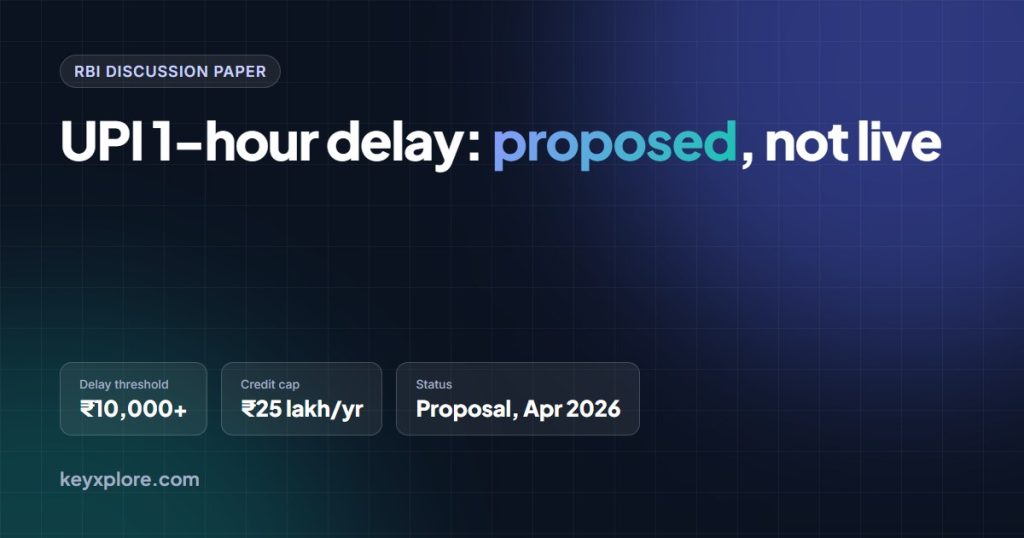
• On 9 April 2026 RBI published a discussion paper, “Exploring safeguards in digital payments to curb frauds”. Public comments closed on 8 May 2026.
• It floats a one-hour lag on person-to-person transfers of ₹10,000 and above, a “kill switch” to disable all digital payments from an account, a ₹25 lakh-a-year credit ceiling for ordinary accounts, and “trusted person” approval for transfers above ₹50,000 by people aged 70+.
• As of 9 November 2026, none of these is in force. RBI has said it will consider draft guidelines after studying the comments.
• What is in force: RBI’s Authentication Mechanisms for Digital Payment Transactions Directions, 2025 (issued 25 September 2025, effective 1 April 2026).
Seen headlines saying UPI payments above ₹10,000 will be delayed by an hour? The plain answer: that is a proposal in a Reserve Bank of India discussion paper, not a rule. Nothing about how your UPI works has changed because of it.
This article explains what RBI actually suggested, what stage each idea is at, and what already applies today. It is general information, not financial or legal advice.
Proposed vs in force: the status table
| Measure | Where it comes from | Status on 9 Nov 2026 |
|---|---|---|
| 1-hour lag on P2P transfers of ₹10,000+ | Discussion paper, Option 1 (9 Apr 2026) | Proposed only |
| Kill switch / channel on-off controls | Discussion paper, Option 4 | Proposed only |
| ₹25 lakh yearly credit ceiling on ordinary accounts | Discussion paper, Option 3 | Proposed only |
| Trusted-person approval above ₹50,000 (age 70+, PwD) | Discussion paper, Option 2 | Proposed only |
| Two-factor authentication for every domestic digital payment, plus risk-based extra checks | Authentication Directions, 2025 | In force since 1 Apr 2026 |
The one-hour delay on UPI transfers above ₹10,000
RBI calls this a “time lag for account-to-account transfers”. The paper says a threshold of ₹10,000 and above per transaction “may be considered appropriate” and that “a lag period of one hour could be applied” at the payer’s bank.
- You could cancel during the hour. The point is to give a victim of a scam call time to stop the payment.
- Banks could step in. If the bank’s systems flag the transfer as suspicious, it may ask you to reconfirm and show a warning.
- Exempt: merchant payments (shop QR codes, online checkouts), recurring payments such as e-mandates and NACH, and cheques.
- Whitelisting: you could mark trusted payees so they skip the lag.
- Still undecided: whether the lag should be mandatory for all or only for risky transactions.
Note the wording: “may” and “could”. There is no implementation date, and the figures could change if RBI issues draft directions.
The “kill switch” and channel controls
Card holders can already switch their cards on and off in their banking app. RBI proposes extending this to every digital channel on a bank account: UPI, IMPS, net banking and wallets.
- Switch each payment mode on or off and set limits by transaction type.
- A single “kill switch” to disable all digital payments from the account at once, overriding other settings.
- Switching back on would need proper authentication, or a branch visit.
- Existing mandates and standing instructions would keep running.
RBI’s Annual Report for 2025-26 also said this facility would be explored for all digital payment modes. It is still not a rule.
The ₹25 lakh yearly credit ceiling
This targets mule accounts, which fraudsters use to receive and move stolen money. The paper suggests a yearly ceiling on total credits, “say ₹25 lakh”, for accounts of individuals, sole proprietorships and partnerships (including LLPs). Corporates, listed companies and government accounts would be excluded.
- Every account would carry a flag, on by default. Your bank could switch it off if you show documents justifying higher inflows.
- Banks could set a lower ceiling.
- Money above the ceiling would sit as a “shadow credit” you cannot use until the bank is satisfied; if not resolved in about 30 days, it would go back to the sender.
Most households never see ₹25 lakh of credits a year. If you run a small business through a personal or proprietorship account, this is the proposal to watch.
Trusted-person approval for seniors
For customers aged 70 and above and persons with disabilities, transfers above ₹50,000 would need a second approval from a nominated “trusted person”. Others could opt in. Changing the trusted person or opting out would take effect after a 24-hour cooling period. Merchant, recurring and cheque payments would be exempt.
What about 2FA and the extra authentication factor?
The discussion paper does not propose new two-factor rules. Those already exist. RBI’s Authentication Mechanisms for Digital Payment Transactions Directions, 2025 were issued on 25 September 2025 and apply from 1 April 2026. They require at least two distinct factors for every domestic digital payment (something you know, have or are) and let issuers add risk-based checks when a transaction looks unusual. Your UPI PIN, OTPs and device-biometric approvals all fit this framework.
Two other RBI drafts are related but separate: the 6 March 2026 draft on customer liability (faster complaint handling and compensation for small-value fraud) and the 11 September 2026 draft SOP on temporary debit holds for suspected mule accounts. Both are still drafts. Wondering about UPI charges instead? See our explainer on UPI charges above ₹2,000 and MDR.
The short version
- No UPI delay, kill switch or ₹25 lakh cap applies today. They are proposals from an April 2026 discussion paper.
- The next step, if RBI takes it, would be draft directions with another comment window, then final directions with an effective date.
- Ignore messages asking you to “update” your UPI for new RBI rules. That is a scam pattern.
- Never share your PIN or OTP, and call 1930 (the national cyber-crime helpline) immediately if cheated.
Frequently asked questions
Is the one-hour UPI delay already live?
No. It is Option 1 in RBI’s 9 April 2026 discussion paper. Comments closed on 8 May 2026 and RBI has not issued draft or final directions on it as of 9 November 2026.
Will merchant payments be delayed too?
Not under the proposal. Merchant payments, recurring mandates and cheques are listed as exempt.
Does the ₹25 lakh limit stop me receiving my salary or selling property?
The proposal lets banks switch off the ceiling for an account when the customer provides supporting documents. The ceiling is a default, not an absolute bar, and corporates are excluded altogether.
Dates and rules can change. Always confirm on the official site: rbi.org.in.