By KeyXplore · Last updated: November 18, 2026 · 8 min read
The short version: most AI agent pilots pass because the demo runs on friendly data with a trusted prompt. Production fails on the boring things: an approval limit the agent cannot enforce, a service that times out halfway through a refund, a ticket that gets processed twice. A control plane (one gateway for agent identity, access and logging) fixes visibility, not reliability. What agents need underneath is an execution layer: small, reusable business tools with the rules, state and rollbacks built in.
You have seen the demo. An agent reads a customer complaint, looks up the order, issues a credit and replies in a friendly tone, all in forty seconds. The room applauds. Six months later the same agent is still “in pilot”, the finance team has quietly turned off its write access, and nobody can say exactly why.
This is not a story about bad models. It is about where agents are placed in the enterprise and what sits underneath them. This article explains why pilots stall, why the popular fix (a control plane) solves only half the problem, and what to build instead. It draws on a talk given at an integration-partner event in Bangalore this month, with the ideas rewritten in our own words and the figures checked against public sources.
The numbers behind the frustration
- An MIT research group’s 2025 report found that about 95% of enterprise generative-AI pilots produced no measurable profit-and-loss impact, and only around 5% reached full production (Fortune’s summary). The sample was small and the finding is about measurable P&L within the study window, so treat it as a signal rather than a census.
- Gartner predicts that more than 40% of agentic-AI projects will be cancelled by the end of 2027, citing rising costs, unclear business value and weak risk controls (Gartner, June 2025). The same note warns of “agent washing”, where chatbots and RPA tools are relabelled as agents.
Both studies point the same way: the problem is rarely getting an agent to do something in a demo. It is getting it to do the right thing, every time, inside a real business process.
Where value actually lives
Picture a company as four layers. At the top sits strategy: operational excellence, customer intimacy or product leadership. Strategy is delivered through business capabilities (say, customer service), capabilities run through business processes (procure-to-pay, order management, dispute handling), and processes run on top of systems and data.
Value is created in the third layer. Systems and data do not make money on their own; a process that runs correctly across them does. That is why an AI assistant rolled out company-wide (the “horizontal” kind: a chat window over your documents) is easy to deploy and hard to tie to a number, while a “vertical” agent that runs one process end to end has a cost, revenue or customer-experience metric attached from day one.
So the design question is not “which systems can the agent connect to?” It is “which process will the agent operate, and what does it need to operate that process reliably?”
A refund that goes wrong: the credit-memo example
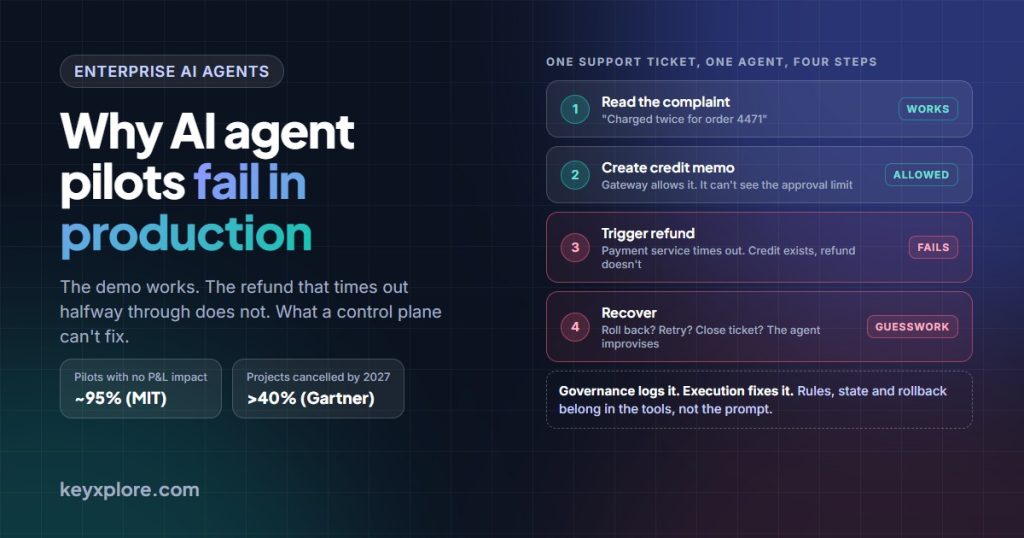
Take a customer-success agent connected to the CRM, the ERP and the service desk. A ticket arrives: the customer was charged twice. The agent identifies the order and decides to issue a credit memo. Three things can now happen that no prompt will save you from.
| Step | What should happen | What a typical agent setup does |
|---|---|---|
| Approval | Credits above a threshold go to a finance manager | The gateway allows the “create credit memo” call; it cannot see that this one breaches the limit |
| Execution | Credit is posted in the ERP, then the refund is triggered | The refund service times out. The credit exists; the refund does not |
| Recovery | Roll back the credit, or retry the refund once, then escalate | The agent “decides” what to do next. It may close the ticket, retry, or do nothing |
| Reprocessing | A second run of the same ticket must not issue a second credit | Nothing tracks that the ticket was already half-processed |
Every one of these is a state and rules problem: approval limits, transaction boundaries, compensation when a step fails, idempotency on retry. Integration teams have handled these for twenty years. Most agent pilots hand them to a language model and hope that good prompting and a long context window will cover it. In a demo, they do. In production, they do not.
Why the control plane is necessary and not sufficient
The industry’s first answer to agent sprawl was sensible. As soon as hundreds of assistants start calling hundreds of vendor-provided MCP servers, you lose track of which agent touched which system with whose identity. The fix is a control plane: one gateway in front of every tool that handles identity, access policy, rate limits, logging and audit.
That gives you security, governance and observability. It does not give you reliability. In the refund example the control plane can log that the refund service failed; it cannot decide whether to reverse the credit. It can permit or deny “create credit memo”; it cannot apply the rule that says this particular memo needs a signature. Governance tells you what happened. Execution makes the right thing happen.
| Need | What it provides | Typical mechanism |
|---|---|---|
| Connectivity | Reach every system in the process, including on-premise ERP, file shares and legacy apps, not just the vendors that ship an MCP server | Integration platform connectors, events, APIs |
| Control | Who may do what, with which data, and an audit trail | Control plane / AI gateway |
| Execution | Business rules, state, transactions, rollback and retries, guaranteed at runtime | Composable business services (“tools”) built on an integration or orchestration runtime |
The three are complementary. The mistake is to buy the second and assume it covers the third.
Build tools for tasks, not wrappers for APIs
The practical shift is small in words and large in effect: give agents task-shaped tools, not system-shaped APIs.
- An API is what a system exposes:
POST /creditmemos. A task is what a person does: “issue a credit for a duplicate charge, within policy”. - A task tool bundles the lookups, the approval check, the ERP posting, the refund call and the compensation logic into one callable unit with a clear contract. The agent calls it once; the runtime guarantees the sequence.
- Tools built this way are reusable across agents and across channels. The same “issue credit” tool serves the support agent, a self-service portal and a human in the back office.
- Prompts shrink. The model’s job becomes deciding whether to issue a credit, not how to walk five systems without breaking anything.
If you already run an integration platform, you probably have most of the pieces: connectors, mapping, error handling, retries. The work is to compose them into named business services and put those behind the gateway, rather than exposing raw endpoints and asking the model to orchestrate.
A reference picture that most vendors now share
Strip the logos off any enterprise-AI architecture slide and the layers are the same: an agent layer (where agents are built and run), a model layer (choosing and calling LLMs), protocols for interoperability (MCP for tools, A2A for agent-to-agent), a context and action layer (how the agent learns what it needs and does things), and connectivity at the bottom.
Viewed from the enterprise side, that collapses into three planes. The reasoning plane decides what should happen. The control plane decides whether it may happen. The execution plane makes sure it does. Most failed pilots have a strong first plane, a growing second plane and nothing in the third.
What to do before your next pilot
- Pick a process, not a use case. “Dispute handling” is a process with an owner, a metric and known exceptions. “Use AI in support” is not.
- List the rules the agent must never break: approval limits, segregation of duties, data that cannot leave a region. These go into the tools, not the prompt.
- Walk the failure paths. For every step, ask: what if this call fails halfway, and what if it runs twice? If the answer is “the agent will figure it out”, you have found your production incident.
- Inventory your connectivity. Which systems in the process have no API, no MCP server and no event feed? Those decide whether the agent can operate the process at all.
- Put a gateway in front of every tool from the first day of the pilot, so you are not adding governance after the agent has credentials everywhere.
- Measure the process metric (cycle time, cost per ticket, refund leakage), not the number of agent conversations.
If the pilot involves ERP or PLM systems, read our note on why ERP–PLM integration projects grow more complex than planned: the same hidden mapping and ownership work sits under most agent projects too.
Frequently asked questions
Why do AI agent pilots fail in production?
Because demos run on trusted data with a hand-tuned prompt, while production needs the agent to enforce business rules, manage state across several systems, recover from failed calls and avoid processing the same request twice. Those are execution problems, and most pilots leave them to the language model.
What is an AI control plane?
A single gateway between agents and the systems they call. It manages identity, access policy, quotas, logging and audit. It gives you governance and visibility, but it cannot enforce business rules inside a transaction or roll back a half-finished process.
What is the difference between horizontal and vertical AI?
Horizontal AI is a general assistant rolled out to everyone, such as a chat tool over company documents. Vertical AI is an agent built to run one specific business process end to end. Horizontal is easier to deploy; vertical is easier to measure.
Is MCP enough to connect agents to enterprise systems?
MCP standardises how an agent calls a tool. It does not cover systems without an MCP server, and it does not provide transactions, rollbacks or business-rule enforcement. You still need connectivity to legacy systems and an execution layer that guarantees how a multi-step process runs.
How many agentic AI projects get cancelled?
Gartner predicted in June 2025 that more than 40% of agentic-AI projects would be cancelled by the end of 2027, mainly for cost, unclear value and weak risk controls. An MIT group’s 2025 report found about 95% of generative-AI pilots showed no measurable P&L impact.
Industry figures are from the sources linked above, checked on 18 November 2026; both studies have known limits and are quoted as indicators, not precise rates. The architecture ideas are drawn from a November 2026 partner event in Bangalore and rewritten in our own words. KeyXplore builds integrations and automation for enterprises; this article does not recommend any specific vendor.