By KeyXplore · Last updated: November 9, 2026 · 6 min read
Quick facts
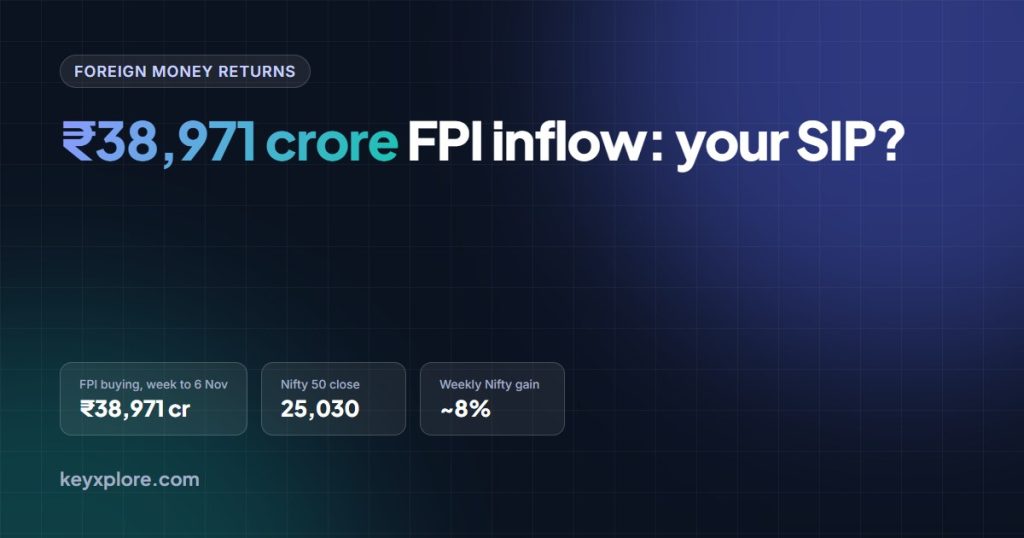
• Foreign portfolio investors (FPIs) bought a net ₹38,971 crore of Indian shares in the week to 6 Nov 2026, according to NSDL data reported on 8 Nov. Exchange-based FII data for the same week shows ₹45,960 crore; the two series are compiled differently.
• Foreign investors were net buyers for 14 straight sessions to 6 Nov, after pulling out about ₹45,162 crore in October (exchange data).
• Nifty 50 closed the week at 25,030, up roughly 8% (reports range from 7.6% to 8.6%), its best week in about six years. Sensex closed at 81,028.
• Trigger: a global sell-off in AI-linked stocks, cheaper crude and a stronger rupee.
• Domestic institutions (DIIs) sold a net ₹24,197 crore in the same week.
If your mutual fund app showed a sudden jump during Diwali week, this is why. Foreign investors, net sellers of Indian shares for most of the past two years, came back in a big way, and the Nifty 50 had its strongest week since 2020.
Here is what FPI flows are, why the money returned, and what it means for a SIP or mutual fund investor. This is general information, not investment advice.
What are FPI flows?
Foreign Portfolio Investors are overseas funds, pension funds, insurers and sovereign funds registered with SEBI to buy Indian shares and bonds. Their custodians report purchases and sales to NSDL, the depository, which publishes the net figure. A positive number means they bought more than they sold.
You will also see a different number labelled FII from the stock exchanges. It counts only exchange trades and comes out the same evening, while NSDL data also includes primary-market deals such as IPO allotments and lands a day or two later. That is why the same week shows ₹38,971 crore (NSDL) and ₹45,960 crore (exchanges). Both point the same way.
What happened in the week to 7 November
| Measure | Figure | Source |
|---|---|---|
| FPI net equity buying, week to 6 Nov | ₹38,971 crore | NSDL data, reported 8 Nov |
| FII net buying, exchange data, same week | ₹45,960 crore | NSE/BSE provisional data |
| Single-day FII buying, Thu 5 Nov | ₹14,975 crore (largest in over a year) | Exchange data |
| FII net selling, October 2026 | ₹45,162 crore | Exchange data |
| DII net flow, same week | −₹24,197 crore | Exchange data |
| Nifty 50 close, Fri 6 Nov | 25,030 | NSE |
Banks and NBFCs led. Shriram Finance, Bajaj Finance, Mahindra & Mahindra, HDFC Bank and Reliance were the top Nifty gainers; Infosys, TCS and Power Grid were among the few decliners. Reports differ on the exact weekly Nifty gain (7.58% by one count, 8.58% by another), but either way it was the biggest weekly rise in roughly six years.
Why foreign money came back
- The AI sell-off. Global investors are questioning how much companies are spending on artificial intelligence and what they get for it. Nvidia logged a sixth straight weekly fall to 7 Nov, and US 10-year yields near 4.9% made expensive tech harder to justify. India’s large listed companies have little direct AI exposure, so India became the ‘non-AI trade’.
- Cheaper oil. Brent crude fell more than 16% in the week to around $98 a barrel. India imports most of its oil, so that helps the rupee, inflation and company margins.
- Stronger rupee. The rupee gained about 1.1% to near 93.90 per dollar, which adds to a foreign fund’s returns.
- Earnings and valuations. Decent September-quarter results, and a Nifty at around 19 times earnings after two flat years.
- US politics. The Democratic midterm win was read as a signal for tighter US spending and a possible easing of the Iran conflict, both positive for oil-importing India.
Keep it in proportion
One week does not undo two years. By one analyst estimate, FPIs sold about $84.5 billion of Indian shares between October 2024 and September 2026; the roughly $6 billion that returned over the last 20 trading days is about 7% of that. Even after the rally, the Nifty ended Samvat 2082 down about 3%. And flows reverse fast: funds that bought ₹14,975 crore on a Thursday can sell as much on a Monday if US data, the dollar or AI earnings (Nvidia reports on 17 Nov) change the mood.
What this means for your SIP
- Your NAV rose; your units did not change. A SIP buys fewer units when markets are high and more when they are low, so this month’s instalment buys fewer units. That is the point of averaging.
- Large-cap and flexi-cap funds benefited most. Buying was concentrated in Nifty heavyweights, especially banks. Small-cap funds moved less.
- Check your allocation, not the news. If equity has grown well beyond its planned share of your savings, rebalance a little. If not, leave it.
- Do not stop the SIP because the market is ‘high’. Foreign selling kept the market flat for two years; investors who kept their SIPs running bought cheaper units that are now worth more.
What not to do
- Do not pour in a lump sum because FPIs are buying. Flows are a lagging indicator; by the time they make headlines, prices have moved.
- Do not chase last week’s winners (NBFCs, banks) through a sector fund unless they were already in your plan.
- Do not read FII exchange data and NSDL data as two different events. They measure the same flow.
- Do not lose track of your own cash flow. A SIP only works if the money is there on debit date; see our guide on tracking UPI expenses automatically.
The short version
- FPIs bought about ₹39,000–46,000 crore of Indian shares in Diwali week, depending on the data source, after selling ₹45,162 crore in October.
- The trigger was a global rotation out of AI stocks, helped by cheaper oil and a firmer rupee.
- For a SIP investor the right response is usually no response: keep investing, rebalance if allocation has drifted, ignore daily flow numbers.
Frequently asked questions
Where can I check FPI data myself?
NSDL publishes daily, fortnightly and calendar-year FPI net investment at fpi.nsdl.co.in. NSE and BSE publish provisional FII/DII figures each evening.
Should I increase my SIP after this rally?
Base SIP increases on your income and goals, not on one week’s market move.
Will FPIs keep buying?
No one knows. Flows depend on the dollar, US rates, oil and how the AI-stock story plays out. Treat any forecast as a guess.
Is my debt fund affected?
Very little. The ₹38,971 crore figure is equity only.
Dates and figures can change as data is revised. Always confirm on the official site: fpi.nsdl.co.in.