By KeyXplore · Last updated: November 16, 2026 · 8 min read
The short version: UPI handled a record 25.47 billion payments worth ₹31.53 lakh crore in October 2026, and almost two in three of them went to a shop or business. A 0.4% merchant fee on larger UPI payments was due to start on 15 October, was pushed back after traders protested, and still has no start date. If your bills are mostly under ₹2,000, or you are a small merchant taking under ₹1 lakh a month by QR, you pay nothing. If you sell bigger-ticket items, start working out the number now.
If you run a shop, a clinic, a petrol pump or a small factory, you have probably had the same two thoughts this year. First: nearly everyone pays by UPI now. Second: someone is about to start charging me for it.
Both are true, and they are connected. This article puts the two together: how big UPI has become, what the proposed fee actually says, who is fighting it and why, and what it would cost a business like yours. We have written it for the business owner, not the customer. If you only want to know whether you will be charged when you pay, read our shorter piece on UPI charges above ₹2,000 instead.
How big UPI is now
NPCI’s October 2026 figures, as reported by MediaNama, are the highest on record on every measure that matters to a business.
| October 2026 | Figure | Change |
|---|---|---|
| Transactions | 25.47 billion | Up 23% on October 2025; up 5.8% on September |
| Value | ₹31.53 lakh crore | Up about 16% on October 2025; the first month above ₹30 lakh crore |
| Per day | 82.2 crore payments, ₹1.02 lakh crore | Daily value crossed ₹1 lakh crore for the first time |
| Payments to merchants (P2M) | 16.09 billion, ₹9.71 lakh crore | 63% of all transactions, 31% of value |
| Person-to-person (P2P) | 9.37 billion, ₹21.82 lakh crore | 37% of transactions, 69% of value |
| Average payment | About ₹1,238 | Merchant payments average much less than this |
| Banks live on UPI | 758 | Up from 756 in September |
Two things in that table matter for the fee debate. Merchant payments are now the majority of UPI by count, so any charge on them touches a lot of shops. And the average merchant payment is small: ₹9.71 lakh crore spread over 16.09 billion payments works out to roughly ₹600 each. That is why a fee that only starts above ₹2,000 leaves most transactions alone, and why the businesses that would feel it are the ones selling bigger-ticket goods and services.
What the fee actually is
MDR, or merchant discount rate, is the fee a business pays its bank or payment provider for accepting a digital payment. Cards have always carried one. UPI has carried none since 1 January 2020, when the government set the rate to zero by law and instead paid banks an incentive from the Budget for small-value payments.
On 15 September 2026, NPCI announced the end of that arrangement for part of the market. The details below are from NPCI’s own FAQ as summarised by SCC Online and Business Today’s 10 November explainer.
| Payment type | Fee |
|---|---|
| Merchant payment up to ₹2,000 | Nil |
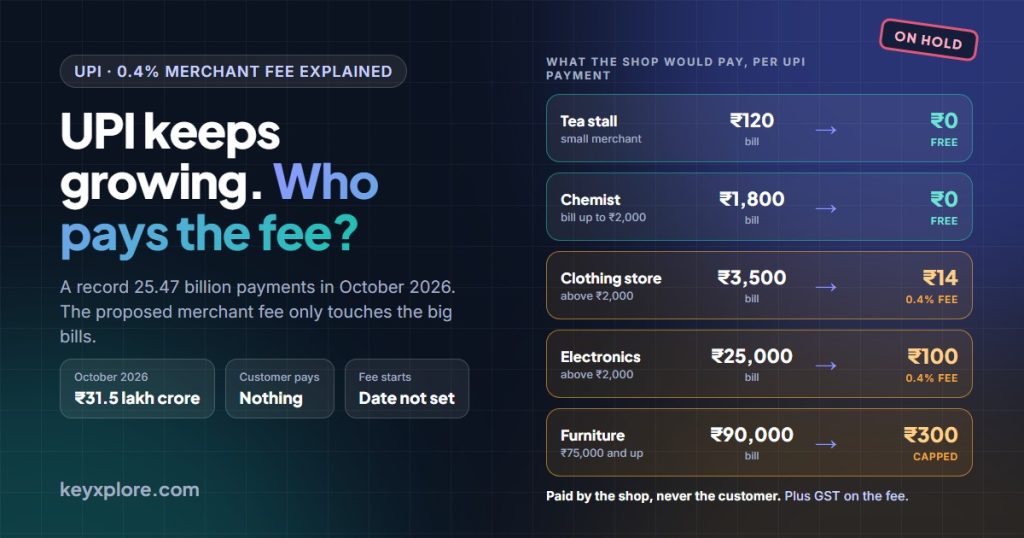
| Merchant payment above ₹2,000 (most categories) | 0.4% of the amount, capped at ₹300 (the cap applies from ₹75,000 upwards) |
| Railways, fuel, telecom, insurance and other notified essentials, above ₹2,000 | Flat ₹5 |
| Mutual funds, securities, stockbrokers, above ₹2,000 | 0.02%, capped at ₹300 |
| Educational institutions, above ₹2,000 | Concessional or capped rate; exact figure not yet published |
| Small merchants (P2PM) receiving up to ₹1 lakh a month by UPI QR | Nil, at any payment size |
| Person-to-person transfers, any amount | Nil |
| UPI AutoPay recurring payments (SIPs, subscriptions) | Reported as exempt; confirm with your bank |
A few points that trip people up:
- The merchant pays, not the customer. NPCI has told the Supreme Court that the ban on passing the fee on is “a mandatory and binding direction”, and that UPI apps cannot add platform fees either. A shop that adds “UPI charge ₹10” to a bill is breaking the rules, and its bank can be made to act. You can, of course, set your prices however you like.
- It is on the whole amount, not the part above ₹2,000. A ₹2,500 payment is charged 0.4% of ₹2,500 (₹10), not 0.4% of the ₹500 over the line.
- “Small merchant” has a definition. The P2PM category is for merchants with turnover up to ₹40 lakh a year, taking payments through a QR code, up to ₹1 lakh a month. Above that monthly limit you move to the regular P2M category. Ask your bank or payment app which category your QR is in; many shops do not know.
- Cards are usually dearer. Debit card MDR for larger merchants is typically around 0.9% and credit cards 1.5% to 2% or more. At 0.4%, UPI would still be the cheapest digital option for most shops. That does not make it free.
Why NPCI says it needs the money
The case NPCI made in its 3 November affidavit to the Supreme Court is simple: somebody has to pay to run the rails. It quotes a Finance Ministry estimate that the industry’s cost of running UPI is about ₹20,700 crore a year, against a Budget allocation of ₹2,000 crore for 2026-27. The gap has been carried by banks and payment apps, which earn nothing on a free transaction and have been pulling back on things like new QR codes and sound boxes for small shops.
NPCI also says the fee is “calibrated”: because it starts at ₹2,000 and exempts small merchants, about 96% of merchant payments will carry no charge at all. And on 11 November it published a scheme, reported here, under which banks and apps put 5% of their MDR income into a fund that pays ₹300 for every new QR code and ₹750 for every new sound box at eligible small merchants, with extra for the North-East, Jammu and Kashmir, Ladakh and smaller towns. The message is that the fee on big-ticket payments is meant to subsidise the small ones.
Why traders are fighting it
The merchant side does not dispute that UPI costs money to run. Its argument is that merchants were asked to adopt UPI on the promise that it was free, built their businesses around it, and are now being asked to fund it while their margins are thin. The timeline of the protest:
| When | What happened |
|---|---|
| 15 Sep 2026 | NPCI announces the MDR framework, to start 15 October. |
| Late September | Traders in Madhya Pradesh hold a “No UPI Day”: QR codes and sound boxes covered in black cloth, customers asked to pay cash. The Ahilya Chamber of Commerce says 125 trade bodies joined across Indore, Bhopal, Gwalior and Jabalpur (report). |
| 23 Sep | The Confederation of All India Traders (CAIT) calls a nationwide “No UPI Day” for 2 October. |
| 30 Sep | A CAIT delegation meets Finance Minister Nirmala Sitharaman and withdraws the 2 October call, citing “constructive discussions” (Business Today). |
| 13 Oct | Two days before the start date, NPCI’s steering committee defers MDR “immediately post Diwali at a date to be notified separately”, citing the festive season (MediaNama). |
| 3 Nov | NPCI files its defence of the fee in the Supreme Court, where the framework has been challenged. |
| 16 Nov (today) | Diwali has passed. No new date has been notified. Reports before the deferral mentioned 1 January 2027 as a possibility; NPCI has not confirmed it. |
What the trade bodies asked the Finance Minister for, according to CAIT: defer the fee past the festive season (done), raise the small-merchant limit from ₹1 lakh a month to ₹5 lakh, keep business-to-business payments out of the framework, and set up a committee to look at the whole thing. Only the first has happened so far.
The strongest practical argument came from the Retailers Association of India: at 0.4%, cash becomes cheaper than UPI for a shop selling ₹5,000 items, so some will quietly go back to it. A survey of 722 street vendors by the Indian School of Business, cited by Business Today, found about half said they would reduce UPI acceptance if charges came in. The Madhya Pradesh petroleum dealers put their own cost at about ₹17,700 a month per pump; fuel has since been placed in the flat ₹5 category, which would bring that figure down a lot.
What it would cost your business
The fee depends almost entirely on your average bill size. Here are six typical businesses. The sales figures are our assumptions to show the method; put in your own.
| Business | UPI bills above ₹2,000 in a month | Monthly MDR (before GST) |
|---|---|---|
| Kirana or tea shop, bills ₹50 to ₹800, under ₹1 lakh a month by QR | None; all payments are under ₹2,000 | ₹0 |
| Clothing store, 400 bills averaging ₹3,500 | 400 × ₹14 | ₹5,600 |
| Clinic, 150 consultations at ₹1,500 and 40 procedures at ₹8,000 | Only the 40 procedures count: 40 × ₹32 | ₹1,280 |
| Mobile and electronics shop, 120 sales averaging ₹25,000 | 120 × ₹100 | ₹12,000 |
| Furniture showroom, 25 sales averaging ₹90,000 | 25 × ₹300 (capped) | ₹7,500 |
| Petrol pump, 2,000 fills above ₹2,000 | 2,000 × ₹5 flat | ₹10,000 |
To do this for your own shop, you need one number: how many UPI payments above ₹2,000 you take in a month, and roughly what they add up to. Multiply the total by 0.4%, cap any single payment at ₹300, and add 18% GST. If you do not know the number, your bank statement or payment app dashboard has it; filtering a month of UPI credits by amount takes ten minutes.
Then compare it with what the alternatives cost you. Cash is not free either: counting, storing, bank trips, change, theft and the discount you give to “adjust” a bill all cost something, and cash sales are harder to prove to the tax department or a lender.
What to do now
- Find out your category. Ask your bank or payment app whether your QR is P2PM (small merchant) or P2M. If you take under ₹1 lakh a month by QR and your turnover is under ₹40 lakh, you should be P2PM and will pay nothing. If you have been set up as a regular merchant by mistake, get it changed before the fee starts.
- Work out your monthly figure using the method above. For most small shops it is zero or close to it. If it is a real number, you have time to plan for it.
- Do not add a UPI surcharge. It is against the rules and your bank can be forced to act on complaints. Adjust prices if you must; do not itemise a UPI fee.
- Keep accepting UPI for small payments. There is no fee under ₹2,000 whatever happens, and customers now expect it. Covering your QR code costs you sales today to protest a fee that may never apply to you.
- Read your payment provider’s notice when it comes. The rate NPCI sets is the maximum. Your bank or app will tell you what it actually charges, when it starts, and how it is settled (deducted per transaction or billed monthly).
- Keep a clean record of what comes in. When the fee does start, you will want to see your UPI inflows by size without typing them into a book. Our free guide to tracking UPI transactions automatically covers the options, including our own app, Cashbook AI, which reads bank and UPI alerts on your phone and keeps a running udhaar khata alongside.
What happens next
Three things to watch. First, the date: NPCI has to notify it, and banks and apps will then write to merchants. Second, the Supreme Court case, which challenges the law that allows the fee; the court asked for NPCI’s explanation and has not ruled. Third, whether the trade bodies’ other demands get anywhere, especially the ₹5 lakh small-merchant limit, which would take a great many shops out of the fee entirely.
Our reading: the fee will come, at 0.4%, and it will apply to a small share of transactions at a modest cost for most businesses. The shops that should pay attention are those with average bills in the thousands, where it adds up to a real monthly line. If that is you, the time to do the sums is now, not the week the notice arrives.
Frequently asked questions
Is there a charge on UPI now?
No. As of 16 November 2026 the merchant fee has been deferred and no new date has been announced. Customers were never going to be charged, and payments up to ₹2,000 and person-to-person transfers stay free in any case.
Who will pay the UPI MDR?
The merchant receiving the payment, through its bank or payment app. NPCI has told the Supreme Court that merchants cannot pass it on to customers and apps cannot add platform fees.
I run a small shop. Will I pay?
Almost certainly not. Payments up to ₹2,000 carry no fee, and small merchants (turnover up to ₹40 lakh, up to ₹1 lakh a month through a UPI QR) pay nothing at any payment size. Check with your bank that your QR is registered as P2PM.
What is the maximum fee on one payment?
₹300. The 0.4% rate is capped there, so a ₹75,000 payment and a ₹5 lakh payment both cost ₹300. GST would be added on the fee.
When will the UPI merchant fee start?
NPCI said “immediately post Diwali at a date to be notified separately”. Diwali was on 8 November and nothing has been notified. Some reports before the deferral mentioned 1 January 2027, but NPCI has not confirmed any date.
Can a shop refuse UPI for big payments?
Yes. Accepting UPI is not compulsory. But refusing it loses sales, and for most shops the fee on a large payment is less than the cost of handling the same amount in cash.
Figures and dates in this article are from NPCI data and the news reports linked above, checked on 16 November 2026. The fee rates are as announced for the original 15 October start; NPCI may change them before the new date. For the official position, see NPCI’s circulars and your own bank or payment provider’s notice. This is general information, not financial or legal advice.