By KeyXplore · Last updated: November 19, 2026 · 9 min read
The short version: SAP organises a company as a tree: client (the whole system), company code (a legal entity that keeps its own books), plant (a physical site), storage location and sales area. Data comes in four kinds: organisational, master, transactional and configuration. ECC is the old ERP, S/4HANA the current one (running only on the HANA database), BTP the platform around it, and Integration Suite (still called CPI) the middleware you will actually touch. ECC’s mainstream maintenance ends on 31 December 2027.
If you build on Salesforce, Odoo or Dynamics and have just been told “the master data comes from SAP”, the first hour of reading is bewildering. Everything has two names, half of them are acronyms, and the SAP team talks about clients, plants and company codes as if everyone knows what they are.
This guide is the explanation we wished we had. It comes from an internal training session where a Salesforce team worked through SAP’s structure with an SAP developer, argued about it, and finally landed on analogies that stuck. Facts have been checked against SAP’s own material; where SAP’s naming is confusing, we say so.
First, the names
| Term | What it is | The Salesforce-world equivalent (roughly) |
|---|---|---|
| SAP ERP / ECC | The classic ERP (ERP Central Component), on-premise, runs on Oracle, SQL Server or other databases | A long-serving legacy system |
| SAP HANA | SAP’s in-memory, column-based database | The database layer; Salesforce never shows you this |
| SAP S/4HANA | The current ERP suite (“Business Suite 4 SAP HANA”), rebuilt to run only on HANA; available on-premise, private cloud and public cloud | The application layer, the equivalent of the Salesforce platform plus its standard apps |
| Fiori | S/4HANA’s web and mobile user interface | Lightning Experience |
| SAP BTP | Business Technology Platform: the cloud platform for extensions, integration, analytics and AI around the ERP | Roughly Heroku plus MuleSoft plus Tableau, sold as one platform |
| Integration Suite / CPI | BTP’s integration service. The message-routing engine was called Cloud Platform Integration (CPI) and most people still say CPI | MuleSoft, Workato or any iPaaS |
| BAPI | Business Application Programming Interface: SAP’s stable, supported function calls for creating or reading business objects | A standard REST API resource, before REST existed |
The thing that trips most newcomers: HANA is a database, S/4HANA is an application suite that runs on it. “S/4HANA Cloud” means the suite hosted by SAP; it does not change the layering. And you do not integrate with the database. You integrate with the application layer, usually through Integration Suite, using BAPIs, OData services or IDocs.
How SAP structures a company
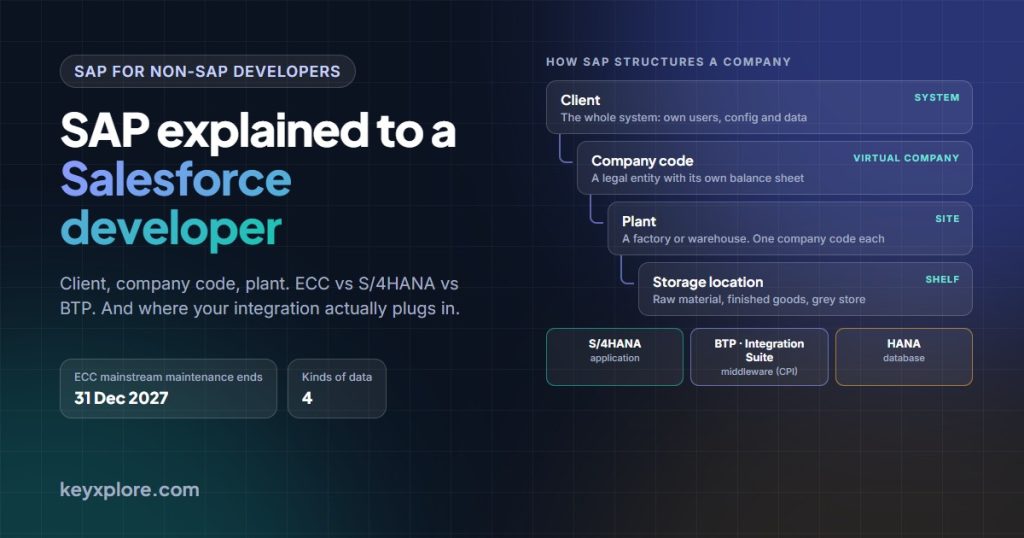
Salesforce gives you one org and lets you model the business inside it however you like. SAP comes with a built-in hierarchy that every transaction must fit into. Here it is from the top down.
| Level | What it means | An analogy that worked |
|---|---|---|
| Client | The highest level in one SAP system. A client has its own users, configuration and data; two clients on the same system share nothing | One big server partitioned into separate instances. Development, test and production are usually separate clients or systems |
| Company code | A legal entity that produces its own balance sheet and P&L. One group can have many | A “virtual company”. Define it by country, by legal entity or by business line, but each one keeps its own books |
| Plant | A physical location where things are made, stored or shipped from. A plant belongs to exactly one company code | A factory or warehouse |
| Storage location | A place inside a plant where stock is kept | A section of the warehouse: raw material, finished goods, grey towel store |
| Sales organisation / sales area | The unit that sells, with its distribution channel and division | A territory with its own price lists |
Two rules to remember. A company code can have many plants, but a plant has one company code. And the hierarchy exists in every client: your development client and your production client each carry the full tree, the same way a Salesforce sandbox carries your object model.
The four kinds of data
The second thing that unlocks SAP is noticing that it separates data by how often it changes.
- Organisational data is the tree above. It changes rarely and only through configuration.
- Master data describes the things the business works with: materials, customers, suppliers, bills of material, routings. It changes occasionally and is shared across the organisation.
- Transactional data is what happens: sales orders, purchase orders, deliveries, invoices, stock movements. It changes constantly and always points at master data.
- Configuration and lookup data are the settings and code lists: material types, units of measure, statuses, grades. Master data is validated against these.
Why it matters for integration: most cross-system projects are master data projects. Nobody syncs a sales order into three ERPs; they sync the material and the supplier so that each ERP can raise its own orders against the same codes. If you are being asked to connect a PLM or a CRM to SAP, start by asking which master objects are in scope and which system owns each one. Our piece on why ERP–PLM integration gets complicated is about exactly that.
Master data is shared, but by whom?
The question that caused the longest argument in that training session: if a supplier exists in SAP, can every plant and every sales area use it? Within one client, yes, master data is shared across the organisational units; a material can exist in several plants with different settings (its “plant view”), while the core record is one.
The problem arrives when a group runs more than one system, say an old ECC on-premise for one business unit and a cloud ERP for another. Now the same supplier can exist twice with different codes, and the same colour can be “navy” in one and “NV-02” in the other. That is why these groups put a product-lifecycle or master-data hub in front of the ERPs as the single source of truth, push the clean record outward, and leave the transactions in each ERP. The integration work is then mostly about the record flowing one way and the acknowledgement flowing back.
A few S/4HANA changes you will meet
- Business partner. ECC kept customers and vendors in separate master tables. S/4HANA has one business partner object with roles; the same partner can be a customer and a supplier. Customer–Vendor Integration keeps the old tables in sync behind the scenes (SAP Learning). If you are mapping Salesforce Accounts, map to business partner and role, not to “customer”.
- Tables behind objects. A business object is a family of tables. Material alone spans the general data (MARA), descriptions (MAKT), plant data (MARC) and more. Integrate through BAPIs or OData, not by reading tables, and remember that a trigger on “the material changed” may be firing on a base table you never see.
- Dynamic value lists. Country-dependent regions, material-type-dependent fields: SAP has had dependent picklists for decades. We compared how the major platforms handle them in drop-downs in enterprise systems.
Where integration plugs in
For a Salesforce or Odoo developer the practical picture is this. SAP’s application layer exposes BAPIs, OData APIs and IDocs. Integration Suite on BTP (SAP product page) is where SAP expects you to build flows that call them: it has adapters for SAP protocols, for REST and SOAP, for message queues (AMQP), and for Salesforce. A company that already licenses SAP will usually prefer to extend with Integration Suite rather than add another platform; an independent iPaaS still wins when most of the landscape is non-SAP.
Two gotchas. Some adapters are only included in paid tiers, so check before you promise a queue-based design on a trial tenant. And an on-premise ECC behind a firewall needs SAP’s Cloud Connector (or a VPN) before anything in the cloud can reach it; that setup is often the slowest part of the project, so start it in week one.
The 2027 deadline
SAP’s mainstream maintenance for Business Suite 7, which includes ECC 6.0, ends on 31 December 2027. Optional extended maintenance runs to the end of 2030 at an extra fee. In January 2025 SAP added a transition option to 2033, but only for customers moving to its cloud ERP private edition, and the CEO said the 2027 date itself “will not be changed” (The Register). Check your own contract for which enhancement package you are on and what applies.
For integration teams this means a great many ECC-to-S/4HANA conversions over the next two years, each of which breaks or re-maps interfaces: business partner instead of customer and vendor, new OData services, changed table structures. If you are building an integration to ECC today, design the mapping so that the S/4HANA move is a re-point, not a rewrite.
A cheat sheet for your first SAP conversation
- Which system and client will we integrate with, and is it ECC or S/4HANA?
- Which company codes, plants and sales areas are in scope?
- Which master data objects are involved, and which system is the source of truth for each?
- Which API will we use: BAPI, OData, IDoc? Who maintains the custom fields on it?
- Is there an Integration Suite tenant, and which adapters does its licence include?
- How do we reach an on-premise system: Cloud Connector, VPN or neither yet?
- What is the S/4HANA plan, and when?
Frequently asked questions
What is the difference between SAP HANA and S/4HANA?
HANA is SAP’s in-memory database. S/4HANA is the ERP application suite built to run on it. You integrate with S/4HANA’s application layer, not with HANA directly.
What is a company code in SAP?
The smallest organisational unit that keeps a complete set of books: a legal entity with its own balance sheet. A group can have many company codes, each with its own plants.
What is the difference between a client and a company code?
A client is the whole SAP system environment, with its own users, configuration and data (development, test and production are typically separate clients). Company codes are the legal entities inside a client.
What is SAP CPI?
Cloud Platform Integration, the message-routing engine that is now the Cloud Integration capability of SAP Integration Suite on BTP. It is SAP’s iPaaS, where you build integration flows between SAP and non-SAP systems.
When does SAP ECC support end?
Mainstream maintenance for Business Suite 7 (including ECC 6.0 on enhancement packages 6 to 8) ends on 31 December 2027, with paid extended maintenance to the end of 2030. Older enhancement packages lost mainstream maintenance at the end of 2025.
What is a BAPI?
A Business Application Programming Interface: a stable, documented function in SAP for creating, changing or reading a business object such as a sales order. It is the supported way to write into SAP from outside, as opposed to touching tables.
Facts checked against SAP Learning, SAP Help and the press coverage linked above on 19 November 2026. SAP’s maintenance terms depend on your contract and release; confirm them with SAP. The analogies are ours and simplify deliberately; SAP, S/4HANA, HANA, BTP and Fiori are trademarks of SAP SE.